
What Today’s Most Effective Leaders Are Secretly Building
Published by Sanita Pukite - on November 6, 2025
5 Capacities Leaders Must Build to Lead From Within 2026
We’re entering a leadership era where capacity matters more than competence. Don’t get me wrong, I am not claiming that competence does not matter. In fact it is one of the core capabilities to build ones authority and advance through leadership ranks, however - they only take you as far as performance. Your capacity is what helps you to help sustain performance under pressure, complexity, and ambiguity.
From my research and through working with leaders across wide variety of organisations, I have identified five capacities that separate reactive managers from adaptive leaders. Learn more through my reflections, incorporating fresh science and real world observations.
1. Emotional Capacity
Feel your feelings without becoming them.
Ability to handle our emotions is not new, however they are increasingly gaining importance in modern leadership. The very recent WEF white paper “New Economy Skills: Unlocking the Human Advantage” outlines the critical importance of human-centric skills going forward (note the change from “soft” to “human-centric skills”).
The Leadership Insight:
Stop trying to change everything. Find the leverage point where one shift cascades through the system.
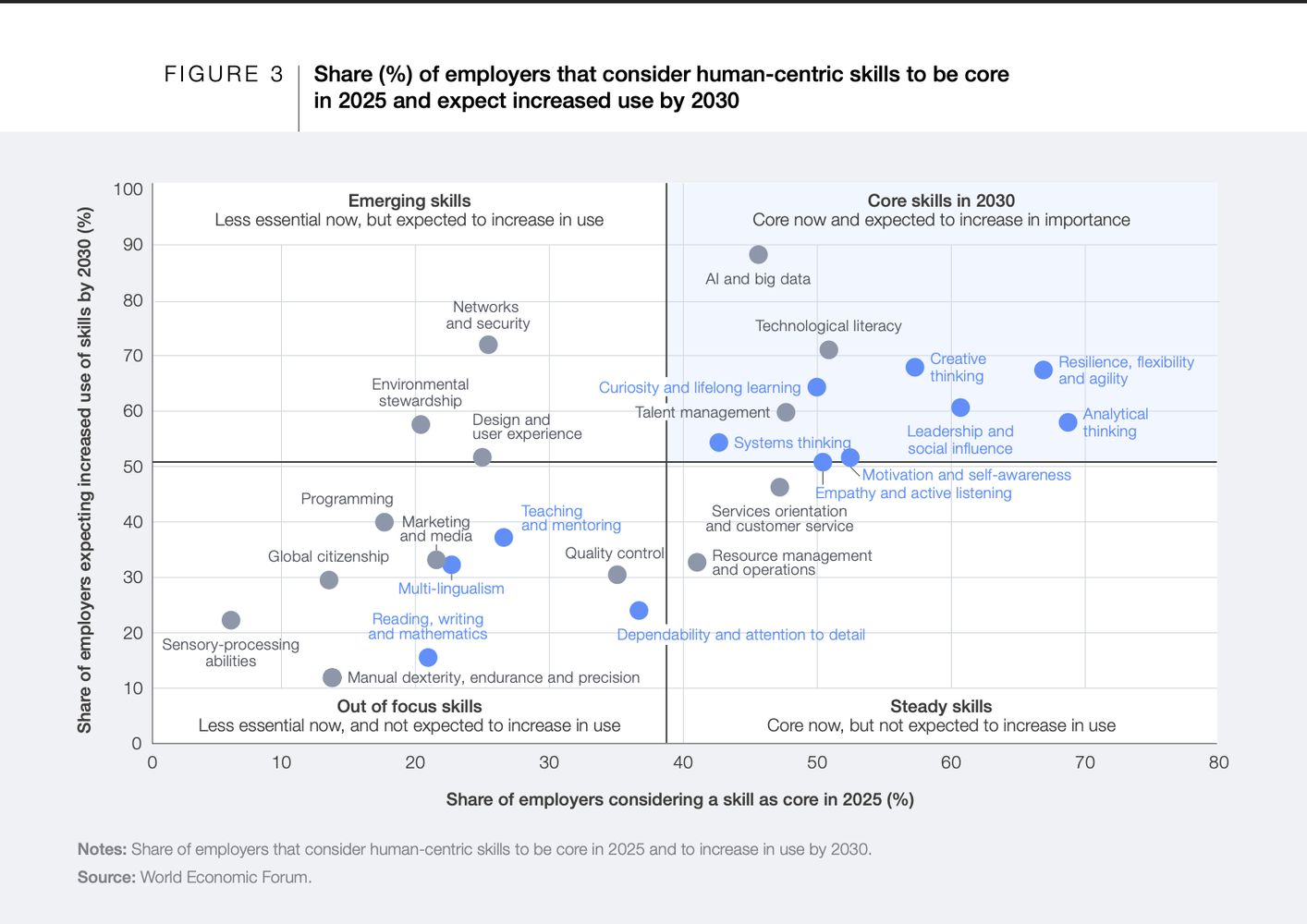
Data tells us that leaders who can experience emotion, especially discomfort, without being hijacked by it make better decisions, stay present in conflict, and expand their leadership range.
Emotional capacity isn’t about suppression of our emotions; it’s about awareness and regulation. When leaders suppress their emotions, they don’t become rational, they become reactive – later. Neuroscientist Prof. Damasio tells us that emotions drive our attention, memory and decision-making. Suppressing them doesn’t make them go away, it makes them show up in a different setting, place and ways.
Burst of anger to the delivery guy, snapping at your loved one or taking it out on an employee who made an insignificant mistake.
High emotional capacity looks like:
Treating feelings as data, not being directed by them
Staying present in difficult conversations
Expanding your leadership range, to be able to respond not react under stress.
Beneath the surface, this is about tolerating internal tension rather than displacing it onto others. It’s about staying with the experience and choosing your next move.
2. Adaptive Capacity
The ability to hold uncertainty without rushing to false certainty.
British poet Keats called it negative capability - the capacity to remain with “not knowing.” Modern leadership desperately needs it.
ADAA (Anxiety & Depression Association of America) reports that 40% of population experience high anxiety and stress in daily lives, whereas we also know from data nearly 70% of senior executives report feeling “overwhelmed” during major role transitions, despite high competence (Korn Ferry). It affects work performance, relationships and quality of work.
However - anxiety isn’t a flaw. Leaders should treat it as a signal. It is data: unmet needs, higher stakes or work that is not yet complete. It is signal to adapt, not to freeze.
Research on adaptive leadership and complexity shows that leaders who can regulate anxiety:
Avoid premature closure. – stay in the “not knowing” until better solutions emerge
Make better long-term decisions
Create psychological safety without lowering standards
Low capacity to manage one’s anxiety leads to control, micromanagement, or performative confidence.
3. Energy Capacity
The ability to sustain leadership over time, not just intensity in bursts.
Tony Schwartz’s mantra “Manage your energy, not your time” isn’t just catchy. It’s evidence-based: our cognitive and emotional systems run on energy, not hours. Leaders who build renewal into their routines sustain clarity and presence.
New CCL (Centre for Creative Leadership) research shows us that at the team level, relational energy - the boost or drain we get from interactions - shape team performance:
Positive interactions elevate engagement and motivation.
A single negative relational energy tie can cancel out four positive ones when it comes to psychological safety and team effectiveness.
Energy isn’t only physical; it’s relational. It is also mental and emotional energy we have to navigate our work and personal lives. Thus self-care and pauses are strategic ways we can continue to sustain it to drive high performance.
If you are curious about your energy levels or what drives or drains it – try the Energy audit or Energy Mapping (Email to learn more).
4. Relational Capacity
The ability to stay connected without over-accommodating or withdrawing.
We don’t lead in isolation. We lead in relationship.
Group dynamics teach us that our habitual interaction patterns - protective withdrawal, pleasing, or dominance - surface most under pressure. The most effective leaders are neither avoidant nor reactive. They stay present, regulate themselves in relationship, and repair conflict quickly.
However, relational capacity is what shows up on the surface. Unless leaders fix the heavy anchor that drags their ability to connect – the past stories, experiences and unresolved conflicts with self and others – they will continue to fall into their reactive patterns.
Attachment theory research show that leaders who can:
Hold boundaries
Stay engaged during conflict
Repair ruptures quickly
…build trust faster and lead teams through change more effectively.
From a psychodynamic lens, this is about resisting & re-writing old patterns and trialing new ones, especially when pressure rises.
Research consistently shows that relational quality predicts engagement and performance, beyond formal support structures.
5. Structural Capacity
The external systems that make inner change sustainable.
Research on behavior change is clear: environment beats intention. Structural capacity turns effort into effectiveness and consistency into results.
Structure - routines, communities, processes turn internal capacity into sustainable leadership practice. They signal to your nervous system that change is safe enough to practice.
Neuroscientist Anne-Laure Le Cunff says that “rituals give the brain structure when life feels uncertain. Their predictability can calm stress, reduce mental load, and improve social interactions”.
What you intend doesn’t happen without systems that reinforce what’s new.
Leaders need:
Support systems to navigate practicalities of life and getting the job done
Clear processes to minimize need to make decisions and to increase efficiency
Communities to lean on for emotional support, insight and to normalize growth
In Summary
2026 leadership isn’t about “doing more.”
It’s about being more capacious - emotionally, energetically, relationally, and structurally.
If you want to expand what you can hold and influence without burning out or falling into complacency or plateau, you have to cultivate these capacities intentionally.
Curious how cultivating these capacities can help you to move to your next level or second curve?
I’m hosting a live webinar “Re-Imagine Your Leadership for your Next Level”.
We will unpack what it takes and how to move to your next level of performance, career step or an entire chapter.
Join me live: January 9th at 10am CET.
https://zoom.us/meeting/register/l76CUo1PTmmnCHL2gRwVfA
References:
1. https://reports.weforum.org/docs/WEF_New_Economy_Skills_Unlocking_the_Human_Advantage_2025.pdf
3. https://adaa.org/workplace-stress-anxiety-disorders-survey

How can I help?
✧ Explore a signature workshop. Bring the High-Impact Leadership Series™ to your organization - experiential learning workshops on clarity, presence, influence, and courageous leadership under pressure. [Enquire here]
✧ Book private coaching. Step into your next chapter with bespoke executive coaching. For senior leaders navigating transition, pressure, or reinvention. [Schedule a chemistry call.]
✧ Want to follow the journey? Subscribe to the LinkedIn newsletter or join my Email reflections - personal, practical, and a behind-the-scenes look at building bold leadership from the inside out.
Let’s shape the kind of leadership the future is calling for - grounded, resonant, and deeply human.