Why expanding leadership capacity starts with what drains it.

A few months ago I was with a leader who, on paper, had everything capacity is supposed to require: experience, real skill, the trust of her peers and her leadership with hard problems. She had just completed a complex change project from start to finish. And she was running on empty.
The project succeeded and got recognised at the highest levels of the organisation. But the credit went to a colleague who had watched from the sidelines while she did the work and absorbed the pressure. Her instinct was the one most of us reach for: push harder, get better at "managing" the difficult people around her. She poured her attention in pushing more, and nothing changed.
The turning point came only when she stopped trying to pour more in the leaking bucket and asked a different question altogether: what is draining me faster than I can recover form it?
Pouring into a leaking bucket won't move us forward.
Most conversations about leadership capacity have a wrong starting point. They teach us how to add: more resilience, more focus, more discipline, more hours of deep work. But capacity is not something we can expand by pouring in more. It is more like a bucket - if it is leaking, everything we add drains straight back out.
The first move in expanding capacity is not to add, nor to do more. It is subtraction: reducing the effect of what depletes us.
This is of course not a new concept. We know the basic mechanism from years of stress research: if our load is higher than our capacity to meet it, the effect is firstly physiological, and then it compounds.
We cannot coach, train, or willpower our way out of a system that is being drained faster than it can recover. So, before we talk about how we expand our capacity, we need to look at what drains it in the first place.
Capacity is an art of holding, not an art of doing.
When I talk about capacity, I don’t mean productivity - how much a leader can get done. I mean the capacity to hold: to stay calm in uncertainty, to tolerate not-knowing without reaching for a premature answer, to contain difficult emotion without being hijacked by it. The word comes from the Latin capax, “able to take in, hold, contain,” and capere, “to take, to seize.”
The poet John Keats called this negative capability. Recent organisational research treats it as a core leadership capacity, one that shapes how leaders engage complexity rather than collapse it. Work on holding environments in organisations frames it well: holding provides containment, the capacity to manage doubt and insecurity, and interpretation, a way to make sense of the experience.
However, when we are depleted, we can’t hold. A depleted nervous system cannot contain; it reacts.
Why subtraction comes before addition.
The neuroscientist Bruce McEwen spent his career on a single, important idea: stress is adaptive in the short term and erosive in the long term. We know from Robert Sapolsky’s research that the body’s stress response is designed for acute threat - mobilise, respond, recover - just like zebras run to escape a lion and then immediately calm down to graze.
Our human problem is constancy. When the stress response never switches off, we are constantly adapting. McEwen called this ‘allostatic load’ - stress that accumulates and begins to change the brain itself. The research tells us that under sustained stress, the regions in our brain that handle judgment, memory and self-regulation loses its footing, while the brain’s threat-detector area grows stronger and more reactive.
In short, the parts of the brain a leader relies on to stay clear and hold complexity get weaker, while the part that scans for danger takes over. We can’t expand our capacity while these processes are running in our brain. We have to ease the load first and only then does the development work have space to enter.
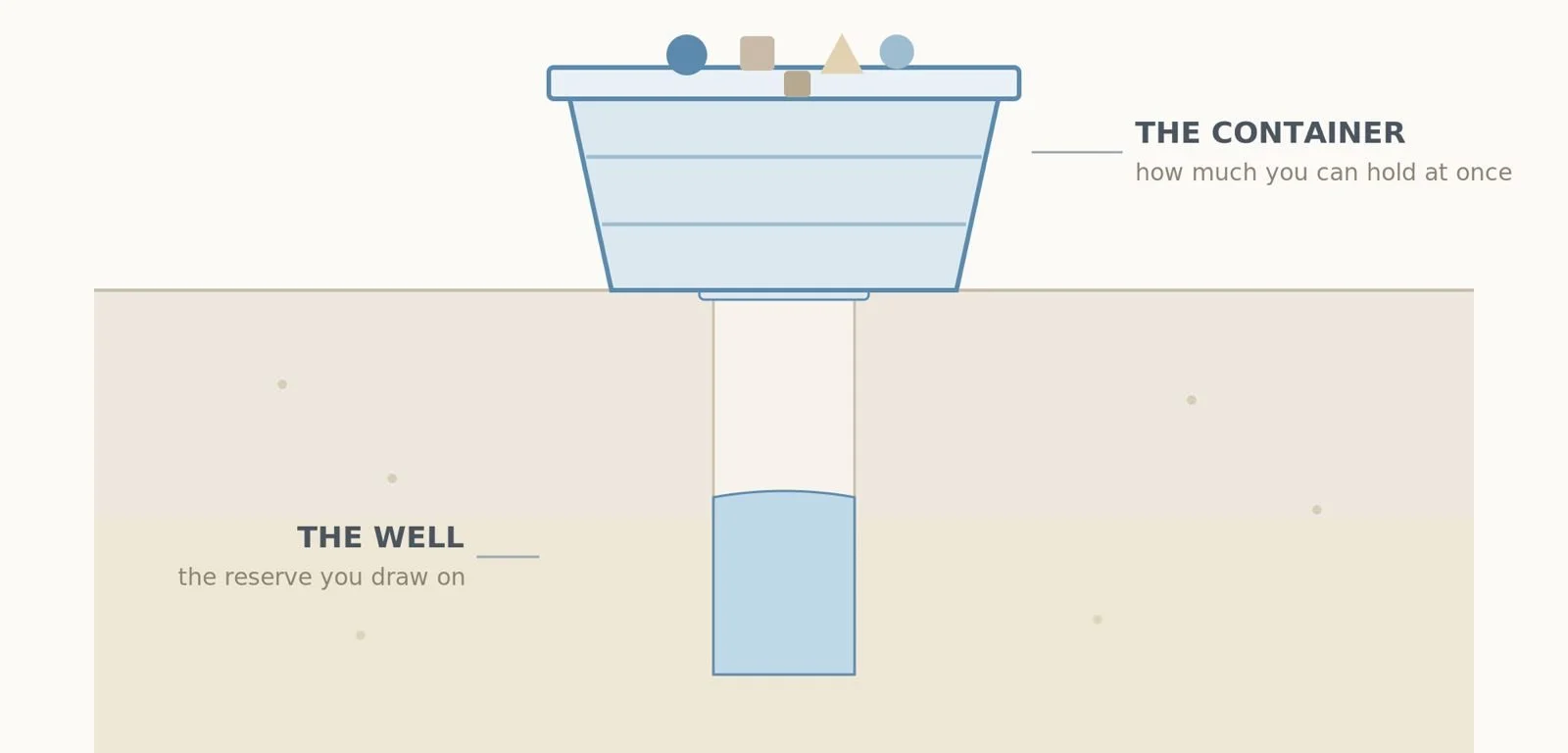
It helps to picture capacity as two things, not one.
There is the metaphor of a container: how much we can hold at once. And beneath it, the well: the reserve we draw on to do the holding. Every demand draws from the well.
The problem starts if the drawing happens faster than the well refills, day after day, with no replenishment in between. A leader might have the skills, intelligence, and all required competencies to handle a massive job. However, if they have run out of deep internal energy reserves (a dry well), and they have not build their capacity over time – they still might fail or fracture under pressure.
Three depletors workplace stress science makes us aware of.
One might wonder -what are some of those stressors that could drain our well? Beyond the obvious physical drains, research talks about three psychological depletors and they are often underestimated because they feel like “just the job.”
Being judged. The most reliable way to spike a stress response is social-evaluative threat. Dickerson and Kemeny’s landmark 2004 meta-analysis in Psychological Bulletin found that tasks combining uncontrollability with the possibility of being negatively judged by others produced the largest and most prolonged cortisol responses of any stressor studied.
Translate this to leadership and organizational environment – we are under continuous social-evaluative threat: visible, accountable, watched. Even writing this newsletter for me poses this threat, if I choose to accept it. And it affects our performance. Beilock and Carr’s research on “choking under pressure” shows that pressure consumes working memory, which in turn affects our judgement.
Role mismatch. Sixty years of role-stressor research reveal one finding: role ambiguity (not knowing what is expected), role conflict (competing expectations), and role overload (role demands exceed resource available) are among the most consistent predictors of strain, burnout, and employee turnover.
This is where the distinction of Role vs. Self matters: much of what exhausts leaders is not who they are but the messyness of the role they’re asked to fill. Things like unclear authority, boundaries of the role, competing mandates, a system handing them unresolved issues and complex challenges expecting fast tracked solutions.
Depletion in such case is already in the system and there is limited ability for a leader to act from high capacity when the environment is constantly draining it. One wont fix it with a resilience workshop or wellbeing initiative; it has to start by clarifying the role itself.
Unbalanced expectations. Capacity drains fastest when effort and reward fall out of balance, and when the demands placed on a person are higher than the resources they’re given. This finding is at the core of every major model of work stress: Karasek’s demand–control model, Siegrist’s effort–reward imbalance, and the job demands–resources framework. It is not as simple as “too much work.”
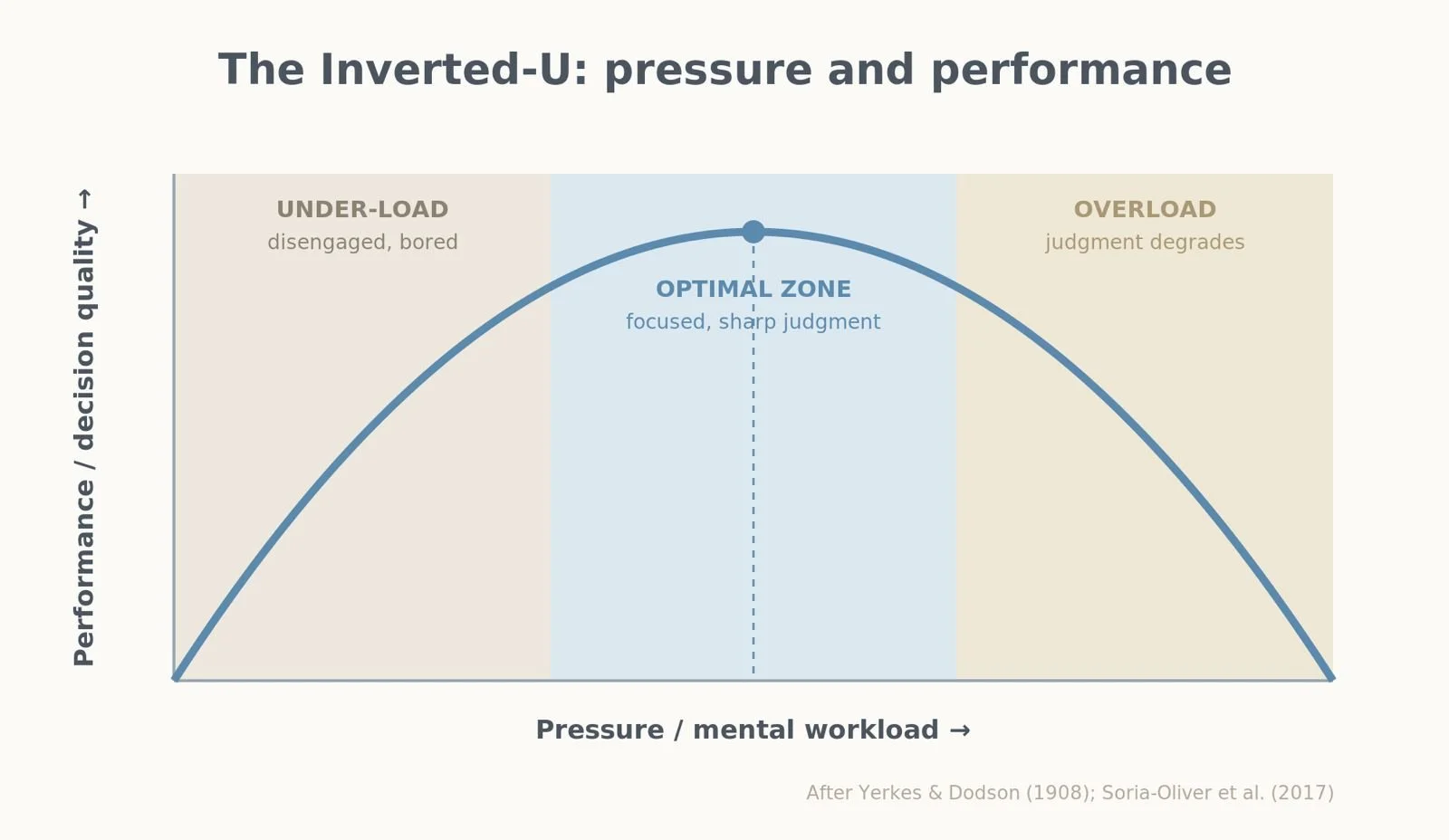
Performance and judgment follow an inverted-U against load: too little and we disengage; too much and our thinking weakens. This is also what another research by Soria-Oliver and colleagues (2017) confirmed for decision quality in an organisational setting. A leader finding themselves at the high-load end of the curve, with no reserve, is operating past their best capability. This is why have a reserve is what helps us to keep our judgment sound.
The leader I opened this newsletter with had a dry well for a reason the research calls out: she put in the effort while someone else received the reward, a textbook effort–reward imbalance - all this inside a role whose recognition never matched its load.
Why it matters?
These three key psychological depletors are not only happening to us. As leaders, we are one of the largest sources of them or one of the strongest buffers against them, for those who work with us. Every week, we are either adding to our team’s capacity or draining it.
Reflection Corner
• On judgment: Does my team feel watched, measured and judged or safe enough to share their mistakes in front of me? Where am I the source of the social-evaluative threat they need to manage?
• On role: Have I given my team a genuine clarity: what’s expected, what they can decide on their own and what they can’t?
• On expectations: Am I matching what I ask of them to what I’ve actually resourced them to do? Have I left for them any margin or any reserve or do I expect their best from a position of no extra space?
And the biggest question from all is: am I the net contributor to my team’s capacity, or a net drain on it?
We cannot pour capacity into our people.
But we can stop draining it so they can hold more and achieve more.
P.S. If you are curious about your own capacity level, take a 24 question assessment by clicking the button below:
Warmly,